
In the era of the image, digital and mass media revolution, survivors remain. In the era of audiovisual chaos there are still visual silences that make themselves apparent. At the turn of the millennium, when we expected to be making frequent trips to the moon, as portrayed in the tales of Jules Verne or Kubrick’s films, we have ended up, figuratively speaking, on another planet, seeking to decipher the complexity of our tiny universe, this microcosm which is the Earth itself. So, in the midst of this tsunami of opposite directions, between progress (what is progress?), and reality (often quite depressing), there are still people who paint, emulating the Atapuerca man, and giving us their feelings in slow motion. People who slow down time, people who keep on painting, who use the brush and canvas as their ultimate technology and who, born in nature, have always recovered what they interpret from this spirit in their creations. “Man was born free and everywhere he is in chains”, said Jean-Jacques Rousseau. Mental, physical, social, cultural chains… that never cease to distract us from essential things, such as marvelling at everyday life, with the small yet great things that the French philosopher sought to enjoy and capture on a daily basis.

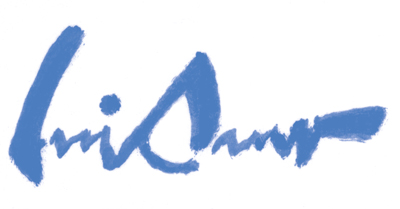
But let’s focus on the subject. Landscape (to put it simply), is everything we see from a window. The window (or in our case, the windows), is the white canvas that will be contaminated or oxygenated in colour and compositional intensity by the brushstrokes of the Barcelona artist, Luis Fernández Amer, known as Luis Amer, whose vocation is painting. His style is the mark of a vision enriched by an almost initiatory journey, which imitates the plein air painters of the beginning of the last century. This book takes us on a journey through a window that breathes nature and humanity.

Besides this, I could also have started by saying that Luis Amer is an artist concerned about his natural environment, from where he quenches his thirst for compositional forms and rhythms. He is a painter who has dedicated his life to a vocation: to painting, drawing and photographing a reality that is slipping away and barely exists now. A reality that he builds by imagining ideal, positive, contemplative and almost unreal spaces. He is a painter who has travelled halfway around the world, putting on exhibitions wherever he has gone. He has always done so in the good company of his landscape and portrait paintings. Amer comes from a generation of painters who, by nature, had a very strong vital appeal in their painting. The artist was nourished on the French-speaking culture of art that came to Catalonia and, mainly, to Barcelona. Paris, as the centre of the art world during the first years of the 20th century: from the legacy of Matisse’s Fauvism and Bonnard’s subtle Nabism to the drive of the textured and structured colour painting of Anglada-Camarasa and Joaquim Mir. Like his teachers, Amer has empowered new generations for many years through the work of his painting school and he has built a bridge between generations, transferring knowledge and refining senses. And he has done so with humility, ingenuity, and from the heart, which is why he is especially loved. The love for culture, which comes from the verb cultivate, only grows from the effort to water the seed of human curiosity on a daily basis, and more than ever during the first few years of life.

Cultural Landscapes

Reflecting on landscapes and landscape painting, which Luis Amer does to his fullest extent, can also mean talking about cultural landscapes, a new concept that broadens our horizons and breaks down boundaries. Landscapes are constantly being transformed, and the cultural narrative seeks to follow these changes from different approaches. Often, however, a landscape changes so much that we can hardly recognise it, and it is often difficult for us to internalise it. The quality of landscapes, therefore, is vital in any civilised society.

In this case, Amer makes it an idealised recreation of bygone times; doing so with melancholy, wishing to go back in time, to revive a remnant of wild nature that bricks and tar have put too much strain on. Other artists do not idealise it, but acknowledge the ambiguities in our management or, directly highlight the incomprehensible aggressions which we have subjected it to. All paths are legitimate, depending on what objective we are pursuing, the will to transgress we want, or the recognition we hope to obtain.

It is clear that the landscape belongs to everyone and that the views we project onto it can enrich, transform or disseminate it. Art and culture are excellent mechanisms for achieving this. Luis Amer knows how to show us a certain moment as an expression of collective life which is always on the move.

Historical relationships: art and landscapes

There has always been a relationship between art and landscape. Starting with our ancestors who, in a healthy exercise of communication and cultural construction, painted the walls of the caves in which they lived. Sgraffito drawings on stone of universal symbols. Taking a leap in time… from carving on rocks to painting them, such as those found at Cap de Creus and portrayed by painters such as Salvador Dalí and Antoni Pitxot. Or the Wagnerian landscapes by Modest Urgell or the deconstructions of Cézanne, all of them seen to a greater or lesser extent in Luis Amer’s imaginary. Today, landscapes and nature are not only a subject to reflect on, but also to interact with through concepts such as “land art”. All these latest artistic movements take geography, adaptation to a place, the architecture of precariousness and everyday life as their leitmotif.

In this regard, the prestige, which is a far cry from that of the 19th century, still endures and gives the landscape an inherited respect which, sometimes distances it. The landscape as a human construct or as a deconstruction of itself are key themes that the works of Luis Amer carry inherently in their DNA. Painting and more painting, in the era of the death of painting. Sometimes, it is the light of his acid colours, but others it is the deep, arid ones, but they always challenge us and hardly ever leave us indifferent.


Alexandra Planas Camps, Writer and Art Critic

Luis Amer’s painting is special, cheerful and refreshing. With a unique colour palette, it reflects very well the Mediterranean lifestyle that represents us.

Optimistic paintings, endearing and everyday scenes that evoke moments that we like to live and remember.

The spontaneity of his culture is transmitted through scenes from daily life. The sunsets with friends, an aperitif in good company, the night of San Juan, a walk along Las Ramblas in Barcelona, ​​the sun, the sea, the beach, the light… are captured in his wonderful paintings.

It is interesting to see how Luis Amer manages to give prominence to each of the layers of his works, thanks to the way he places the colour, achieving a magical contrast of lights and shadows.

The intensity of his colours makes his painting truly attractive.

The presence of the female figure and details such as her dresses, her bows, her gestures, her caresses… convey sweetness, tenderness and serenity.

The artist goes beyond painting. The importance of architecture and the element of fashion are constantly present in some of his works, creating a painting of the current moment.

Josep Tuneu i Valls – Traumatology Specialist

“In Wildness is the preservation of the world and the world’s leading experts tell us that the best protector of human biodiversity will be equilibrium with other species and environments.”

Henry David Thoreau – Poet and Philosopher

“What should be first sought using all methods is silence. For this reason, I find it ridiculous and superfluous to try to explain painting in words. What words, what phrases could express the silent, secret and obscure spaces, which we all want to find the meaning of and which we all want to take something away from?”

Balthus – Painter

“I have to be in Portlligat, watching the fishermen, the colour of the olives and bread, feel the peace, the landscape, with its anointing and inner piety. I need the localism of Portlligat just as Urbino needed Raphael to arrive at the universal by the path of what is particular.”

Salvador Dalí – Painter

“I like the painted landscape. I like to contemplate a real landscape even more. And what I like most of all is to actually become a part of the landscape, something small which is contained in the landscape.”

Josep Pla – Writer

“The paintings of Luis Amer inspire imagination, joy and happiness in me; it is the pure air of the Mediterranean, he is a great inspiration in my career because he uses a great palette of colours; as my great MAESTRO Alfredo Kraus used to say: “SINGING IS EASY, THE DIFFICULT THING IS TO SING WELL” and for that you have to use a broad palette of colours like the great painter and artist Luis Amer does.”

Antonio Gandía – Tenor

“What fascinates Luis Amer, more than one particular landscape or another (although, of course, whatever the landscapes may be, it is that at a given moment they have seduced or inspired him) is the landscape itself; the landscape as an entity, with its own full and unrepeatable existence, as a real part of the world, completely differentiated from it and, yet resembling it, unequivocal and diverse, multiple but invariable in its essence.”

Rafael Santos Torroella – Art Critic

“Art seems to be the determination to decipher or pursue the imprint left by a lost form of existence.”

María Zambrano – Philosopher

“For years, Luis Amer’s art has enjoyed a strategic place in our home. At dawn, its light inspires us to start a new day… At dusk, its spirit calms our hearts for a blessed night. Sparks of colour that are food for the soul!”

Josep Lagares – Executive Chairman of METALQUIMIA

“Luis Amer’s painting gives me the presence of the light and colour of the Mediterranean. I’m “hooked” on this painting, because it relaxes me when I look at it, filling me emotionally because it transmits life. Luis Amer makes colour, tenderness and his perspective lead you to be part of his painting. It has given me great pleasure to be able to contemplate his work.”

Dr. Bonaventura Clotet – Scientific researcher on HIV and Corona Virus and other infectious diseases- “Yo Me Corono”_ Director of the IrsiCaixa laboratory

“Fortunately, although rarely, contemporary painting awakens sensations and attracts us through its play of colour, by highlighting the beauty of our daily life and the beauty of the environment. Luis Amer’s pictorial work is, in my humble opinion, an excellent demonstration of how art can, and should, influence our lives, bringing light, vitality and splendour through the selection of beautiful post-impressionist scenes and using colours that, without doubt, attract one’s attention to their surroundings, never going unnoticed and producing a magical impact of hope and positivism.”

Antoni Esteve – Pharmacist

The musical phrases offered by Luis Amer’s symphony of colours run through Mediterranean landscapes in a very simple way, with its pleasant sea, its attractive beaches, sailing boats and its sun lovers. The rhythmic alternation of colours chosen from a nice palette transmits plays of lights and shadows in line with Matisse and Bonnard of the last century and maybe more recently Sanvisens and Ortuño.

L’Altrange – art lecturer

Luis Amer is the great Fauvist of the Mediterranean. Its amazing gleams and generous chromaticism inebriate us until we are transported to another marvelling dimension. The Amer’s expressionism is a gift of joy and optimism.

Fernando Alcolea – collector, and researcher

Luis Amer, impressionist painter with strength in his brushstroke and a light in his artworks that does not leave indifferent.

His exquisite way of treating colours, they express positivism and strength. Remembering painters from the end of the last century, Luis Amer has managed to update the nuances and make contemporary artworks full of life and colour that bring you to these places and make you want to live.

Cuca Iriarte – appraiser and expert in the art quotes market

Luis Amer’s ignited chromatism

Luis Amer, a Barcelonan who travelled the world with a five-year stay in Portugal, is an artist who combines the multiple Catalan traditions in landscaping with landmarks to which he’s linked, such as Anglada Camarasa, Joaquim Mir and Sanvisens, blending the chromatic freedom, in which warm colours stand out, approaching a certain kind of Fauvism, in which nature flows like a vital glow of spots that turn into spaces where emotions survive with expressionist nuances that define a reality as close to geography as to the heart of the creator.

Carlos García-Osuna – Editor of the magazine Tendencias del Mercado del Arte